Sunday, July 09, 2006

MoPR's Gotta Brand New Blog

Incredibly, this two week old blog has become very popular. We've started getting lots of emails from people, which piqued our curiosity. So we started measuring our traffic and found we had 5 or more unique visitors per hour! That’s after only two weeks with no promotion.

We think our "success" must be attributed to Blogger, which gave us an exceptional platform to start keeping a record of our thoughts on mobility and public relations (and, of course, Mobility Public Relations). Despite the fact that we love Blogger (we raise our glasses and toast you Blogger!) and recommend it to every new blogger without reservation, it was time to take our little blog to the next level.

We’ve moved our location to themoprblog.com. Please update your link. Our RSS feed URL has been updated to http://themoprblog.com/feed/. If you’re using our FeedBurner feed, we updated that for you (and thus you should not be reading this post).

Let us know what you think of the new look and feel. We’re still working to get things completely updated and we’re tweaking all the bells and whistles of the new site. But we also have a day job, so please be patient.

We’ll be seeing you on TheMoPRBlog.com!

Thursday, July 06, 2006

TAXI !!!


Beyond the ability to stay connected and productive from wherever you happen to be on a given day; business travelers and road warriors also yearn for a means of travel that will get them from A-to-B in the shortest amount of time and with the least amount of hassle.

While we don’t yet have the ability to call our own personal transporter chief and say “Beam me up Scotty,” so called Air-Taxis (or Air-Limos) have been generating a whole lot of interest of late, and might be just what the mobile businessman (or woman) is looking for.


According to interviews I’ve heard, there are more than 19,000 airports in the United States, but only some 400 offer scheduled commercial flights. That leaves several thousand smaller airports out of reach to the average business traveler. Often times these smaller airports are a lot closer to where we want to be for business and sales calls. The idea of an Air-Taxi is a smaller, lighter, more affordable alternative to a private jet; but with the same on-demand kind of availability.


For more information on some of the players in this hot space, check out the websites of Air-Taxi operators DayJet, Linear Air, and POGO.


Technology guru Esther Dyson recently covered the air taxi trend in the June issue of her Release 1.0 Newsletter. In this issue, titled, “Visible Demand: The New Air-Taxi Market,” Ether writes:

“The air-taxi market is not about luxury travel or vacation getaways. It's about productivity: more time on the ground to make that extra sales call before getting home for dinner, instead of getting caught in the productivity-sapping hub-and-spokes commercial flight system that takes all day (not to mention a hotel stay), leaving room for only one sales call.”

Esther also produced an interesting video on the subject, including an interview with Vern Raburn, CEO of Eclipse Aviation (a company manufacturing the jets that are making this trend a reality).

Business 2.0’s Saheli S.R. Datta also put together a thorough review of the Air-Taxi trend in an article this month titled, “Hailing The Air Taxi.”

I’d love to hear from some frequent business travelers about the kind of impact you expect this could have on you personally (So post your comments here). How many of you have already thought about building Air-Taxis into your corporate travel strategy? Are you seeing Air-Taxis as a viable alternative to driving from small city to city and losing time on the road? How much value do you find in the ability to potentially set your own air travel schedule? This is a trend that Mobility Public Relations will be watching as it will undoubtedly have a big impact on the way business travelers think about mobility.

Wednesday, July 05, 2006

Into the Blogosphere

The Blogosphere...

Our blog is not even two weeks old, but we're already getting lots of e-mail from people we don't even know. We sent all our friends links to our blog when we first started it. Glenn Fleishman included a link to it on his Wi-Fi Net News blog. I guess word of the MoPR blog is spreading.

Knowing that other people are reading and enjoying -- dare I say, even learning -- from our blog is pretty cool, and we're enjoying creating the posts.

Taking the blog to the next Web 2.0 level is going to be fun. The next level is full of interactivity between you and us... between your search for knowledge and our wisdom; between our wisdom and the wisdom stored on the Internet; between the wisdom stored on the Internet and your personal pages.

It will take a lot of work to find the right harmonic between our posts and our audience, but no one is more committed than the creative people of Mobility Public Relations.

More to come.

John S

LinkedIn: John Sidline
Wireless World Forum: John Sidline
MySpace: Dr. Johnny Spin
Yahoo 360: Dr. Johnny Spin

technorati tags:
del.ico.us tags:
icerocket tags:


blinkbits
BlinkList blogmarks co.mments connotea del.icio.us digg Fark feedmelinks Furl LinkaGoGo Ma.gnolia NewsVine Netvouz RawSugar Reddit scuttle Shadows Simpy Smarking Spurl TailRank Wists YahooMyWeb


Monday, July 03, 2006

Mainstream Mobility: "Dreams of a Truly Mobile Web"

Net Needs to Escape Its Computer Cage, But Best of Luck Freeing It in the U.S.

It's a longstanding maxim of this column that the future generally doesn't arrive with a lot of flash and noise -- instead, it sneaks up on you. One day you notice you're reading your news online, banking via PC and downloading stuff from eMusic, and try to remember the last time you flipped through the physical newspaper, wrote a paper check or bought a CD.

By Jason Fry
July 3, 2006

CLICK FOR COMPLETE ARTICLE

Sunday, July 02, 2006

MoPR Mobility Minute: Highway Hi-Fi


Because of the show Rock Star: INXS (soon to be a subject of another post), I started uploading lots of 80s music to my iPod. A friend asked me if I liked INXS back in the 80s, and I responded, “You bet I did! I had all their cassettes!”

Cassettes were awesome! You weren’t just restricted to listening to albums, but you could easily record your own playlists, like a real disk jockey! Most of these custom cassettes were recorded one at a time, painstakingly in the order of how we wanted to hear them – at least at the time we made the recording. Remember how cool it was when someone invented the fast-forward feature that could stop in the silence between the end of one song and the beginning of the next? That allowed us to fast-forward over the song we regretted accidentally putting on the tape.

But to enjoy my music collection in my car meant bringing with me something that resembled a suitcase, which I had keep stashed underneath the passenger seat whenever I parked the car. If you had a car in the 1980s, you also had that suitcase – don’t lie, of course you did. We all did. Anything smaller than that suitcase would limit you to some unsatisfyingly small number of cassettes (some older folks remember the steamer trunk sized container of 8-tracks they had to lug around to enjoy their music collection in their vans back in the 70s).

The advent of CDs reduced the suitcase to a “wallet” or even a smaller collection fanned across the back of a sun visor. When CDs became recordable, man that was revolutionary! We still painstakingly recorded songs one at a time to create our own playlists, but at least the music was digital.

The thing is, people have always wanted to bring the entertainment media they enjoy along for the ride. It’s all about having anything you want, anytime you want it, anyplace you are.

Chrysler Motors knew this, even way back when. In 1956 they teamed with CBS to create the “Highway Hi-Fi” – an under-dash phonograph that played vinyl records at a super-slow 16-2/3 revolutions per minute. The slow speed allowed a small disc to pack up to an hour of entertainment on each side. Special mechanical engineering reduced the number of times and distance the needle would skip across the disc as the car drove over bumps in the road.

Technology really didn’t catch up with Chrysler’s vision until the invention of the iPod. The iPod lets you carry with you virtually your entire multimedia library wherever you go.

Now cars come equipped with iPod-ready sound systems. You can control your iPod from the steering wheel as the device sits in the cradle getting charged. Of course satellite radio is there for those times when you grow tired of the 60 megabytes of music you have stored on your iPod. And just in case, the theater-quality surround sound works great with the built-in DVD player (with a cartridge to keep multiple DVDs ready to play).

If only there was a way to listen to INXS in the front while the kids watch Sponge Bob in the back…

Friday, June 30, 2006

Mark Your Calendars

Being responsible for HR at MoPR, I feel I should alert everyone to upcoming holidays in the month of July.

To our Canadian friends, happy Canada Day (Saturday, July 1st). Of course Tuesday, July 4th is Independence Day in the USA. Our offices will be closed for both holidays.

July is also an important month for the public relations industry as we celebrate Public Opinion Day on July 24th, commerating the publication of the first public opinion poll in 1824.

There are many other holidays in July as well, so please mark your calendars:

July 5th is Workaholics Day, but at MoPR we'll also celebrate it with a 12-hour workday on July 3rd. July 9th is Rock and Roll Day. Those of you hiring interns this summer, please remember Intern Appreciation Day on July 10th. July 10th is a two-fer as it is also Don't Step on a Bee Day. It's okay to step on bees the rest of the year. The week of the 10th is very crowded with nationally-recognized holidays, but don't fret: Cheer Up Day is the 11th and Simplicity Day is the 12.

The 14th of July is the day which we acknowledge our friendship with France by celebrating National French Fries Day.

Mother's Day and Father's Day are behind us, but please remember the rest of your family. Cousin's Day is July 24th and Aunt and Uncle Day is on the 26th.

The last Sunday of July is Comedy Celebration Day, this year on July 25th. I would be remiss if I didn't point out that the 28th is Accountant's Day (we love you Matt!).

Please don't forget that the United States Congress has designated the month of July as National Baked Bean Month as well as National Ice Cream Month. Nothing against beans, but I'll be celebrating Ice Cream Month this year. That will be easy as the third Sunday this month (the 16th) is Sundae Sunday, also known as Ice Cream Cone Day.

Visit American Greetings and Activity Connection for more holidays in July.

Check back next month for the holiday schedule during National Brownies at Brunch Month.

On the road for nicknames...

One good turn deserves another (pun intended), and since Will Ferrell, in character as Gene Frankel, has already appeared on this blog - making him a regular - I thought it important to note that he has been signed by Sprint Nextel to star in a line-up of new commercials.

The series of commercials, which will be appearing starting this Saturday, will feature Ferrell as Nascar driver Ricky Bobby - - a fictitious character from the new movie Talledega Nights: The Ballad of Ricky Bobby. According to BrandWeek, Ricky Bobby will be promoting the exclusive movie content available on Sprint phones. I wonder if Ricky will be recommending fans tune into Sprint's new FanScan service, where you can access live in-race communications from your Sprint phone, and listen to the pit crews, spotters, and even the owners communicating with the drivers during a race. A FanScan Race pass will run you $4.99. I imagine the PR team could do something really cool with FanScan for the launch of Talledega Nights (that was a freebie Sprint, call MobilityPR for further brainstorming).

The Talledega Nights Sony Web site is packed with cool features; including a spot where you can find out what your race car driver nickname is. Afterall, without a sweet nickname, you're nothing in this business.

Sidline's handle is : "The Supercharger"
Gidding's is: "The G0-Rilla" And mine is: "The Master Cylinder"

Find out what yours is here! (And then post a comment to this post to let us know how your Nickname suits you)

Thursday, June 29, 2006

MoPR Mobility Minute: Portable Computers

One of the advantages of growing up the son of an engineer is inheriting castoff computers. This benefit is particularly of value in college.

My friend Matt and I were two such lucky college kids. Not only did we get old computers, but they were portable! That meant we could bring our computers to the popular San Francisco coffee houses, libraries, even to classes to take notes.

Um... No, we couldn’t.

"Portable" simply meant that when we had to move out of our respective domiciles at the end of the school year, we had an easier time packing our computer than, say, our stereo.

The year was 1986, and Matt and I each had different portable computers. We frequently debated as to which one was better (nerd alert). Matt had the slightly older Osborne 1 while I had the Kaypro II. There were many similarities but the two computers were vastly different.

Matt’s Osborne 1, built in 1981, sported the Zilog Z80 microprocessor (the very same chip used in Radio Shack’s TRS-80 models II and III) with a super fast clock rate of 4.0 Mhz. It, of course, had 64 kilobytes of RAM. It packed 24.5 lbs of technology into its sleek plastic suitcase-shaped case (the top of which contained the keyboard).

My Kaypro II on the other hand, built in 1982, had a slower Z80 chip, only 2.5 Mhz. It also weighed a heavier 26 lbs and was in a squared off metal case (the top of which contained the keyboard). Fine, the Osborne 1 looked sportier. But drop the Osborne and you run the risk of damaging the inside, while the Kaypro was boxy but safe, just like a 1982 Volvo sedan.

But even more than that, the Kaypro II had dual 195 kb floppy disk drives (way back in the 1980s, computers had disk drives for “diskettes” that were 5 ¼ inches in diameter which were indeed floppy. These diskettes held more data and were far easier to manage than their 8 inch predecessor. Can you imagine carrying around 8 inch disks? No, 5 ¼ inch was the way to go). So my Kaypro II was able to put a program disk in Drive A with software that was up to 195 kilobytes in size. I could also put a second data disk in Drive B that could store up to 195 kilobytes of files.

Matt, on the other hand, had measly dual 91 kilobyte drives. That meant that the word processor he was using, for example, was as much as 100 kilobytes smaller and thus far less powerful than mine.

Matt’s display was also a paltry 5 inches wide and could only display 53 characters across! Whereas the Kaypro II had a 9 inch display that could display 80 beefier characters on the same line. And who says size doesn’t matter? Not only that, but the Kaypro II’s display was green (from electronically charged phosphorous) which, legend has it, was easier on the eyes.

Both computers sold for about $1,700 when they were new. They both used the CP/M operating system (a lot like MS-DOS, but without all the fancy bells and whistles). But I think you will agree with me that the Kaypro II was by far the superior machine.

Of course, the reason that we got these computers was that our fathers got new computers and no longer needed these. I don’t know what Matt’s dad got, but my father replaced the Kaypro II with the state-of-the art in mobile computing: the Compaq Portable II. Understand, that a lot had changed between 1982 when the Kaypro II was made and 1986 when the Compaq Portable II debuted.

The Compaq Portable II was simply a lot more computer that you could also carry around. It cost more too, with prices closing in on $5,000. But you got the latest Intel 80286 microprocessor that had a clock speed of at least 6 Mhz but maybe as much as 8 Mhz! You only got a single 5 ¼ inch double-sided floppy drive, but it held 360 kilobytes of data! It also came with 256K of memory (or as much as 640K!). It still had a 9 inch monitor for 80 character lines, but it had something else that neither the Osborne 1 nor the Kaypro II ever had: a hard drive. An actual drive that stayed inside the computer at all times where you could store all your programs.

The hard drive on my dad's Compaq Portable II was a whopping 10 Megs! To put that in perspective, you would need just over 51 of the 195 kilobyte floppy disks to store all the software you could on just one 10 megabyte hard drive. Can you imagine carting around 51 diskettes? (Actually, you could, because in order to back up the hard drive, you had to save all the data on 28 diskettes, but that’s beside the point).

You no longer had to use CP/M. It was replaced with MS-DOS (a lot like CP/M, but with fancy bells and whistles).

By the way, the Compaq Portable II weighed 26 lbs, the same as the Kaypro II. But as you can see from this picture, the Compaq Portable II was a quantum leap in mobile computing from the Osborne and Kaypro dinasours it replaced.

How far has mobile computing come in the 20 years since the Compaq Portable II hit the market? The Dell notebooks used by Mobility Public Relations weigh less than 5 lbs and have Intel’s Core Duo T2400 microprocessors with a clock speed of 1.83 Ghz (somewhere in the neighborhood of 230 times faster than the Compaq’s chip, but the chip actually processes data far faster than that), comes with 2.0G of memory (roughly 3,125 times the amount of memory the Compaq could max; but the Dell can go to 4.0G), and has an 80GB hard drive (which holds 8,000 times more data than the Compaq’s). That's important because Microsoft Word is 11.5 megabytes (that's 1.5 megabytes larger than the Compaq's hard drive and about the size of 60 floppy disks on the Kaypro II).

The display on the Dell is a 14.1 inch wide-screen set at 1280 by 1024 pixels with four bazillian colors or something like that (as compared the two colors of the Compaq) which means the Dell can do one more important thing that the Compaq, Osborne and Kaypro never could: play video games!

Mainstream Mobility: "Square Feet. Oh, How Square! "

The rise of mobile workers has companies unloading space and rethinking what's left

Chances are that on any given day up to 40% of your colleagues are not in the office. Instead they are working in rumpled T-shirts on their sofas, long-hauling it to Asia for client meetings, or mooching Wi-Fi and power in some café. The professional class is going bedouin, as some in Silicon Valley say.

By Michelle Conlin
July 3, 2006

The MoPR Blog Cam

Battle tested in the most challenging of environments (the MoPR road trip), the Cingular 8125 is the MoPR camera phone of choice. It has a 1.3 megapixel camera that was able to capture almost all the important moments of our lives, three seconds after they took place.

Melissa's takes pictures only in sepia now (on purpose).

This phone rocks! It has Windows Mobile 5.0 with Outlook, so we get all our email right off our server. Synchs our calendars and contacts. It has Word, Excel and Powerpoint. It even has Adobe Acrobat! I read my efaxes right off my email on my phone! (Yeah, they're all spam faxes, but that's not the point... I can read them on my phone!).

We used the speaker phone on mine for a conference call in Vancouver.

The best feature, besides the camera of course, is Bubble Breaker. Bubble Breaker is Tetris on acid. We're all competing now for high scores.

The Cingular 8125 is made by Taiwanese handset manufacturer HTC under the name "the Wizard." (If anyone from HTC marketing is reading this blog, we love your phone and want to represent you in North America.) T-Mobile sells a version, and I've seen this phone all over Europe. There is a web community dedicated to it, too.

When you see pictures on this blog of any of the MoPR gang, chances are it was taken by "The Blog Cam" -- our much beloved Cingular 8125 mobile phone.

Wednesday, June 28, 2006

That's Gold Jerry!


Our excellent photo shoot in Seattle took advantage of the seriously groovy architecture of the Experience Music Project, and despite Rodan’s laser-guided dooty, I’m sure we’ll have a bunch of fine pix to share with you soon.

So I’m just standing there at one point watching the proceedings and before you can say “that’s gold Jerry!” I realize fate has put me in this place and at this time for a reason: I must photograph John S snapping a pic of uber-photog Jeff who is photographing my MoPR comrades Melissa and Stacy. Now I know how that photographer felt when those Marines raised the flag on Iwo Jima.

MoPR Mobility Minute: US Patent 2,292,387

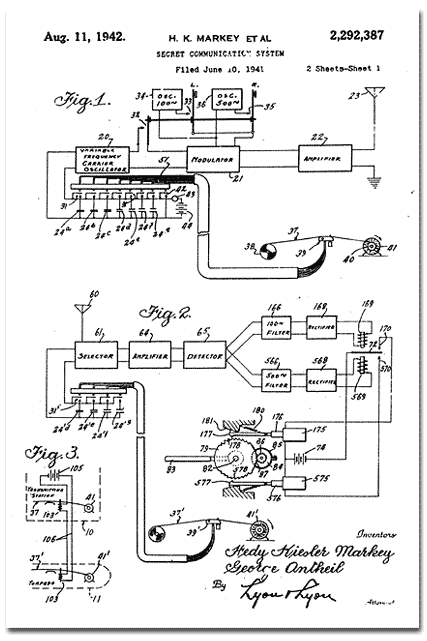
The patent for "Secret Communications System" was granted August 11, 1942 to H.K. Markey, et al. The patent is often referred to as the “Markey-Antheil” patent for the two principal inventors.

The primary purpose of the invention was for the remote control of torpedoes from aircraft. The problem it solved was the jamming of radio frequencies that could disrupt communication between an aircraft and the dirigible craft (torpedo) it was guiding.

The technology applied to overcome radio jamming is called signal hopping. Both the remote craft and the guiding craft had radios that were synchronized using a paper roll, not dissimilar from the paper rolls used in player pianos such as the Pianola. Eight different frequencies were coded onto the paper roll, and as it turned it caused the radio signal to switch frequencies simultaneously at both ends of the transmission.

This particular patent was never built into a product, and the patent eventually expired in 1959. However, the technological concepts of the patent continued to inspire engineers. In 1957, engineers in Sylvania’s laboratories replaced the paper roll with electronics and created a more advanced means of transmitting signals over multiple radio frequencies. This time, the technology was used for secret communications, utilized on US Navy ships during the Cuban Missile Crisis as just one example.

Today, more than 1200 patents refer to this original patent, all based on “signal hopping” or, as it is better known today, “spread spectrum.” The technology originally meant for military application to send a single data stream over multiple radio frequencies is now used to break data up into small packets that can travel on multiple frequencies or even multiple networks. US Patent 2,292,387 contains the basic technology for such everyday modern mobility technologies as digital cellular phone systems like CDMA (code division multiple access) and Wi-Fi (IEEE 802.11) wireless Internet.

Who was H.K. Markey? Markey was her married name (one of her six married names). The inventor of spread spectrum technology was actress Hedy Lamarr (1913 – 2000). Co-inventor George Antheil (1900 - 1959) was a concert pianist and composer; hence the paper roll resembling one in a Pianola and eight different frequencies like the eight notes in an octave.

MoPR Mobility Minute: Walkie Talkies

Three names are associated with Walkie Talkies. Alfred J. Gross (1918 - 2000), Donald Hings (1907 - 2004) and Paul Galvin (1895 - 1959). But it appears that Canadian-born/American-raised inventor Alfred Gross built the first portable radio device in 1938 (Canadian Hings built his portable radio for the Canadian military in 1942).

Gross, who has a number of US patents for mobile radio technology, once demonstrated his invention to a secret classified meeting of the FCC in 1944. The demonstration inspired FCC Commissioner E. K. Jett to write an article, "Phone Me By Air," published in the Saturday Evening Post in July, 1945:
"Now, for good or evil, comes the Walkie-Talkie for civilians. Just radio, 'Bring home an extra lamb chop,' or, 'I want to report a strange man' - You can keep quiet, if you wish - but you probably won't."
The era of mass mobile communications predicted by Jett was still decades away, however.

Paul Galvin's company, The Galvin Manufacturing Company (later renamed Motorola), mass produced the Walkie Talkie for the US Military in the lead up to and during World War II.

The journeyman Walkie Talkie was the SCR-300 made by Galvin's company, which delivered nearly 50,000 for Allied Forces in both the European and Pacific war theaters. When we think about Walkie Talkies today, we think about small handheld devices. But in the late 1930s and early 1940s, Walkie Talkie equipment was fitted into backpacks and weighed approximately 35 pounds.

By 1942 the first handheld radios -- or Handy-Talkies -- were deployed.

Communications devices were becoming more portable. But these devices used radio frequencies in the same way radio stations do. A broadcast of signals from the transmitting device to any receiver within range. Not exactly private or secure. And not without other problems, too. For example, military radios were often jammed by the enemy to disrupt communications. Network-based communications was still to come.

More information on Walkie-Talkies and Handy-Talkies can be found on the US Army Signal Center online museum of Fort Gordon, GA.